
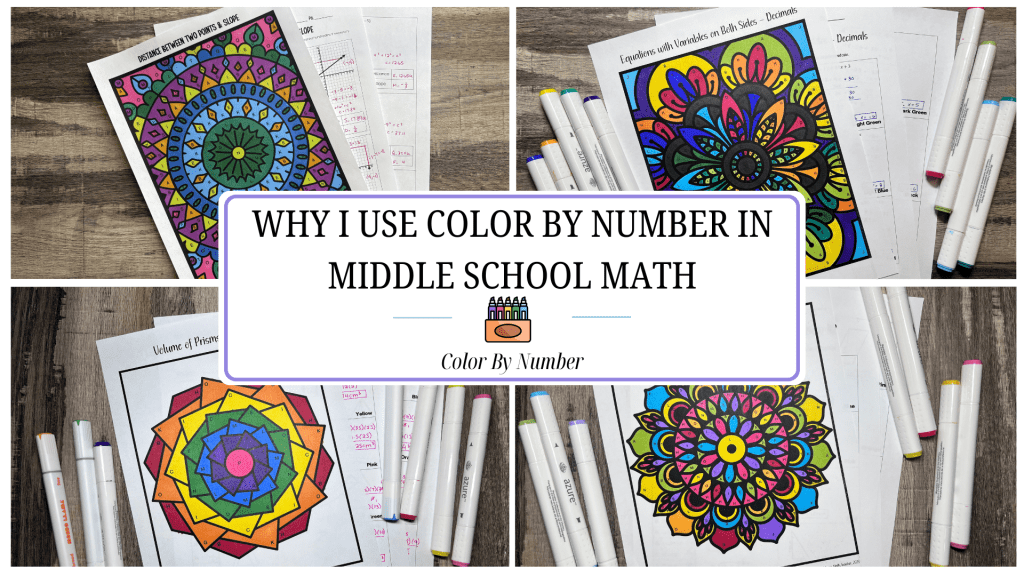
Middle school math asks a lot from both students and teachers. You’re balancing new concepts, filling in gaps, managing behavior, and trying to keep everyone engaged—all in the same 45–60 minutes. Color by number activities grew out of that reality: they’re designed to make meaningful practice feel more approachable and sustainable, for you and for your students.
In this post, I’ll explain what my color by number activities are, how they’re structured, and why they work well in real classrooms.
What Are Manic Math Teacher Color by Number Activities?

At their core, color by number activities are structured practice pages paired with a coloring sheet that reveals a design only when the math is done correctly.
The format is intentionally simple:
- Students complete a set of problems on a worksheet.
- Each correct answer connects to an item in a built‑in answer bank.
- The answer bank provides a letter, number, or code that appears on the coloring page.
- Students use that information to color specific sections of the design.
When they’re finished, the design is complete and accurate—because it reflects correct math work.
The coloring page is a reward and a visual payoff, but it’s always connected to the practice, not just a separate art project.
How the Answer Bank Supports Self‑Checking
One of the most important features of these activities is the answer bank. Instead of waiting for the teacher to grade everything, students can check themselves as they go.
The answer bank:
- Shows the set of correct solutions for the problems.
- Lets students match their own work to a visible, structured list.
- Signals when something needs to be reviewed—if an answer isn’t in the bank, they know to reconsider their steps.
This approach encourages:
- Error analysis, rather than guessing and moving on.
- Ownership of learning, since students see immediately whether their work makes sense.
- More efficient teacher time, because you don’t have to be at every desk to provide basic correctness checks.
The goal is not perfection on the first try, but a steady process of solving, checking, and correcting.
Why Coloring Helps Students Stay Engaged
Coloring sometimes gets dismissed as “extra,” but in a structured academic context, it can actually support learning.
Color by number activities can help students by:
- Lowering stress during practice. Math can feel high‑stakes; pairing it with a calming, repetitive task like coloring can make students more willing to stick with challenging problems.
- Promoting focus and persistence. Knowing there’s a design to reveal gives students a reason to complete the entire set of problems, rather than stopping halfway through.
- Supporting visual processing. As patterns and colors fill the page, students experience the payoff of following a series of steps carefully—a parallel to following mathematical procedures.
The coloring is structured and purposeful, so it becomes a built‑in brain break that keeps students on task rather than pulling them away from the math.
Built‑In Differentiation
Real classrooms are full of students working at different speeds and levels of confidence. Color by number activities are designed to meet those differences without requiring separate sets of materials.
Teachers use them to:
- Provide independent practice for students who are ready to work on their own, with the answer bank serving as a quiet guide.
- Support small‑group instruction, while other students continue practicing independently.
- Give early finishers a meaningful extension, since coloring the design is directly tied to completed, checked work.
- Offer extra time to students who need it, without penalizing them if they don’t reach the coloring stage. The core learning and feedback live in the problem pages themselves.
Everyone uses the same resource, but each student’s experience can look slightly different depending on their pace and support needs.
Versatile Uses in the Math Classroom
Because the structure is consistent across the color by number line, the activities can be used in many different ways:
- As bell work or warm‑ups on review days.
- As independent or partner practice in the middle of a lesson.
- As part of a rotation or station model.
- As spiral review to revisit previously taught skills.
- As sub plans when you want something engaging and self‑contained.
- As test prep when students need a change from traditional practice formats.
Once students learn how the answer bank and coloring page work, you can reuse the structure throughout the year with different content.
The Intent Behind the Product Line
These activities were created with a few core goals in mind:
- Rigor first. The math problems are designed to be real practice, not filler.
- Feedback built in. The answer bank gives students information about their work without requiring constant teacher grading.
- Engagement that feels authentic. The coloring component is meant to reduce anxiety and increase persistence, not distract from the learning.
- Consistency across resources. Once students understand the format, the directions feel familiar every time, which saves you instructional minutes.
The hope is that color by number becomes a trusted routine in your classroom—a way for students to know what to expect while still being challenged by the math.
 MANIC MATH TEACHER